
The twelfth supercomputer in the world and the papers of the Resistance
· ELAN42
A shorter English version of an article first published in Italian on elan42.com on 13 August 2026 and updated in October.
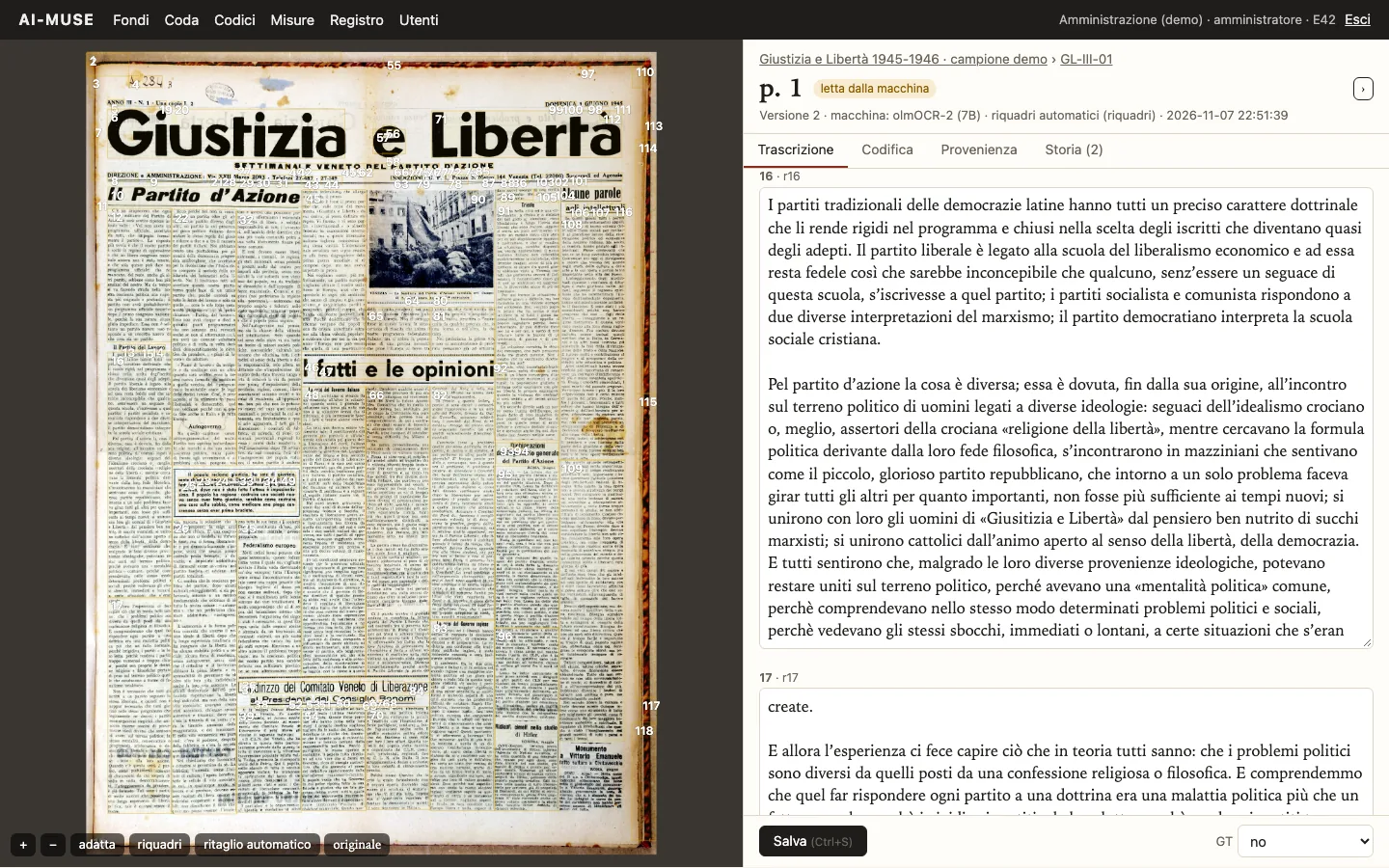
When we think of the civil engineering that built a country, we think of bridges, dams, motorways and railways: public money spent to carry a nation forward. Today some of the most important public works are made not of concrete but of silicon, compute nodes and data.
Leonardo, the supercomputer of CINECA in Bologna, is one of them: an infrastructure built to speed up research and innovation, twelfth in the world in the TOP500 list of June 2026. This is how we brought it to the papers of the people who founded the Italian Republic.
The limit of eight gigabytes
In an earlier project, ELAN42 read 7,444 pages of a nineteenth-century dictionary in about 140 machine hours, on a single 8 GB consumer graphics card, locally, with no cloud spend at all. The hard part was not the language but the layout: three dense columns sent the models into loops, repeating themselves in output that passed for text.
That worked for structured print. Handwriting and damaged historical documents need models that do not fit in 8 GB. The book no longer fitted on the shelf.
Thirty-two times larger
In August we applied through EuroHPC, and within days AI-MUSE was granted compute resources through the IT4LIA AI Factory (EuroHPC), project EHPC-AIF-2026PG01-1068. Processing runs on Leonardo Booster at CINECA, Bologna: 5,000 GPU hours, to be used by 24 November 2026. Each Booster node carries four GPUs with 64 GB of memory: 256 GB per node, against our eight.
We asked for little on purpose. The work on text keeps running on our own hardware in Venice. From Leonardo we ask only for the one stage that does not fit at home, recognising handwriting at scale, for AI-MUSE: reading the historical sources of European archives and museums with open-source models, in a workflow where the machine assists and the curator has the last word.
Where engineering meets the founders of the Republic
IVESER, the Venetian institute for the history of the Resistance and of contemporary society, has joined AI-MUSE and is opening its archives to it. Some of its documents are technically very hard. Take the clandestine press of 1943-45: sheets duplicated in secret from hand-cut stencils, with uneven ink, show-through and crooked lines.
The women and men who printed papers such as «Fedeltà all'Italia», «Fronte Unico» or «Giustizia e Libertà» in 1944 were laying the foundations of a democratic country. They did it with makeshift means, risking their lives for every leaflet, and left documents that an ordinary machine today cannot read. We are taking the highest point of this decade's public investment in infrastructure, a supercomputer built for science, and using it to keep the memory of the people who built that country by fighting for it.
A graph of memory
Reading the text is only the first step. From 34 consecutive issues of «Giustizia e Libertà», June 1945 to January 1946, 70 pages in all, the machine also picks out the people, places, organisations and ideas they mention and links them. The result is a graph of 575 notes and 4,322 connections that shows the structure of the collection at a glance: the Partito d'Azione and its newspaper at the centre, and around them a long tail. Of the 416 people, places, organisations and ideas, 299 appear on a single page. That tail is where the value of the collection lies: local militants and partisans whose names would otherwise be lost.
The limits of AI, and symbolic harm
We checked the 951 links to Wikipedia that the machine had made in the text: 251 of them, 26%, were wrong or suspect. In an archive of the Resistance a wrong entity is not a technical defect. It is symbolic harm. Left to itself, the machine turned politics upside down:
- «fascist SS», in the account of an ambush of January 1945, linked to the Red Brigades, an organisation founded in 1970;
- the National Council of the Partito d'Azione linked to the National Council of the National Fascist Party;
- the Fronte della Gioventù of the Resistance taken for the youth wing of the neo-fascist MSI.
An archive with wrong links is worse than an archive with no links. A broken link can be seen; a historical error hides in the text.
So the work is organised so that the machine assists and a person decides. A surname on its own, such as «Prefetto Matter», gets a list of candidates and the curator picks the right one, once for the whole collection. Misspelt names are matched only above a strict threshold, and the candidates are reviewed by hand. The placeholders a model writes when it does not know are made to fail visibly instead of passing for links. The machine is very good at normalising variants, turning «P. d'A.» into Partito d'Azione, but accepting its corrections is always a person's call, not least so that it does not quietly modernise the language of the time.
Human digital is not rhetoric
Today those sheets cannot be read by a machine, so they cannot be found, and an archive that cannot be searched might as well not exist. Putting them back into circulation with a supercomputer is what we mean by human digital: the infrastructure of the future, used to protect the people who gave us one.
Since then
On 6 November 2026 we read fourteen pages of «Giustizia e Libertà» on Leonardo with two models, and trained our own recognisers for Greek, Latin and Arabic handwriting. What came out, with the numbers.