Case studies
Three kinds of material that general-purpose reading software handles badly, each for a different reason: crowded newsprint, old handwriting, and music.
«Giustizia e Libertà», Venice 1945-1946
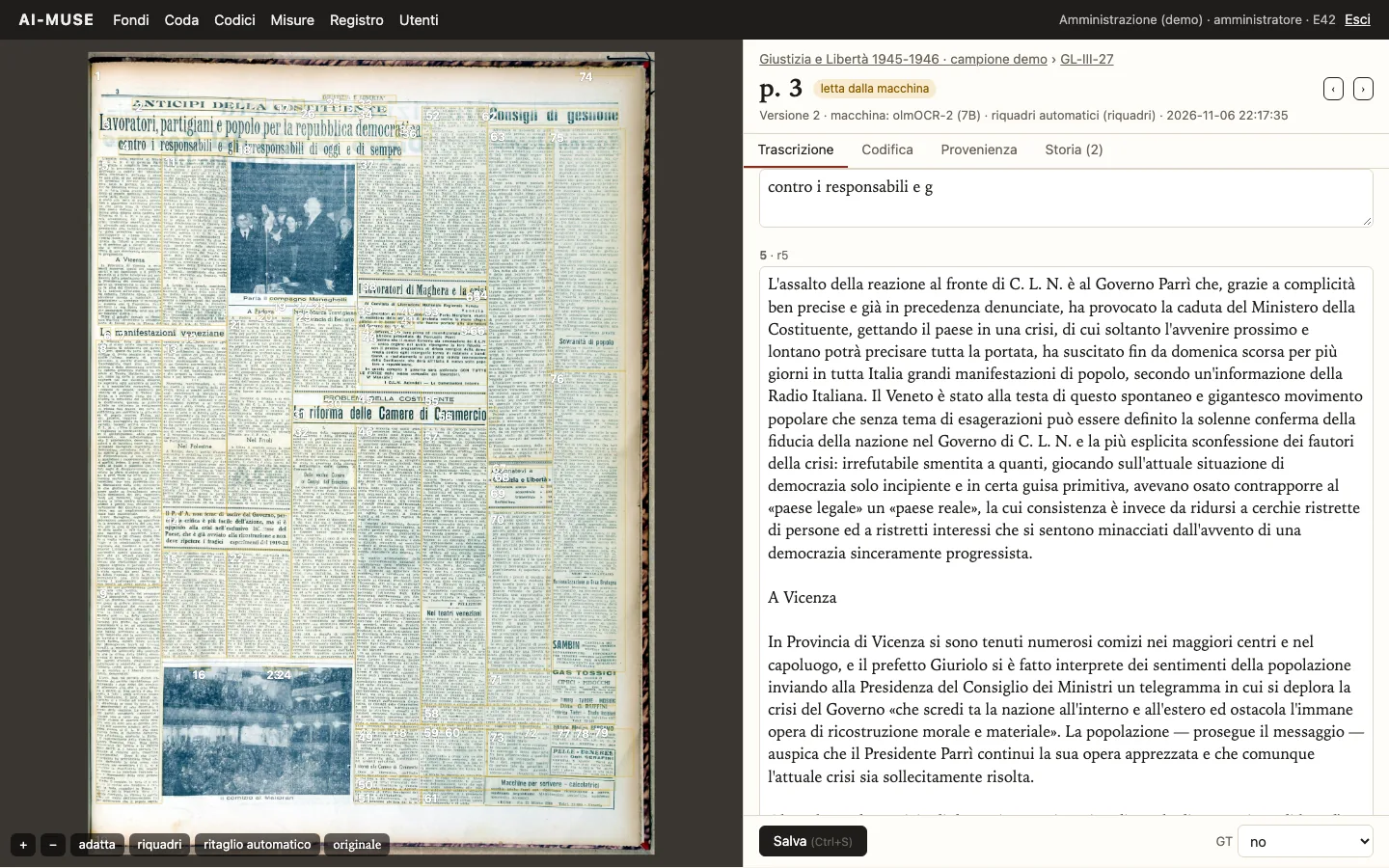
The weekly that the Partito d'Azione printed in Venice from the summer of 1945 is held by IVESER, the Venetian institute for the history of the Resistance and of contemporary society, which shared with us the scans of the run from June 1945 to January 1946: 70 pages. Six columns of small type on wartime paper, mirror images of the reverse showing through, a date misprinted in a masthead.
On 6 November 2026 we read fourteen of those pages on Leonardo with two models, after cutting each page into blocks. Both readings are in the editor, where IVESER's curators can compare them and correct the better one. Their corrections on a handful of pages will give the first measured error rate on this newspaper, and the material to train a model for it.
Greek, Latin and Arabic manuscripts
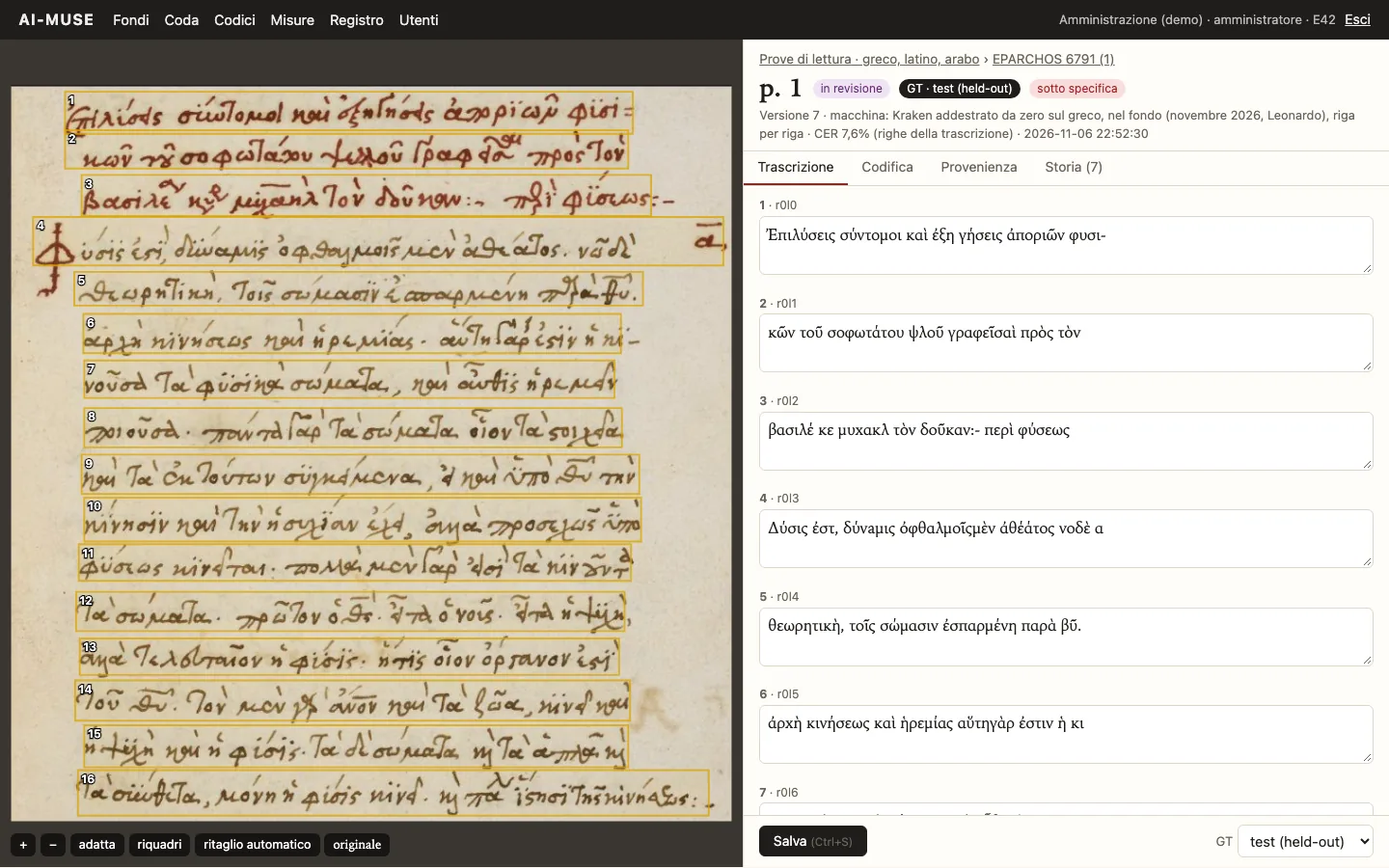
To measure honestly we needed pages that are hard and that come with a human transcription. Eight such pages come from public datasets, each kept out of training. The datasets also gave us the material to train our own recognisers, all under licences that allow it.
- EPARCHOS, Greek cursive of around 1500: A. Papazoglou, I. Pratikakis, K. Markou, L. Tsochatzidis, 2020, Zenodo, CC BY 4.0.
- Stavronikita Monastery, collection 114, Greek minuscule: I. Pratikakis, A. Papazoglou, S. Symeonidis, L. Tsochatzidis, 2021, Zenodo, CC BY 4.0.
- Patrologia Graeca, OCR ground truth of the CGPG project: C. Vidal-Gorène, B. Kindt, 2026, Zenodo, CC BY 4.0.
- Codex Palatinus graecus 23, the Palatine Anthology: M. Guénette, M. Verstraete, A. Chagué, M. Vitali-Rosati, HTR CPgr23, CC BY 4.0.
- e-NDP, chapter registers of Notre-Dame of Paris, 1326-1504: J. Claustre, D. Smith, S. Torres Aguilar et al., 2023, Zenodo, CC BY 4.0.
- TranscriboQuest 2024, medieval literary manuscripts: C. Vandyck, J. Dummer, E. Kuhry et al., 2024, Zenodo, CC BY 4.0.
- Agapet, Christian Arabic manuscripts: H. Ibrahim, G. DiRusso, 2025, Zenodo, CC BY 4.0.
- RASAM, Arabic Maghribi script: C. Vidal-Gorène, N. Lucas, C. Salah, A. Decours-Perez, B. Dupin, ICDAR 2021 workshops; transcriptions Apache-2.0, images of the BULAC in the public domain.
Mozart and Beethoven
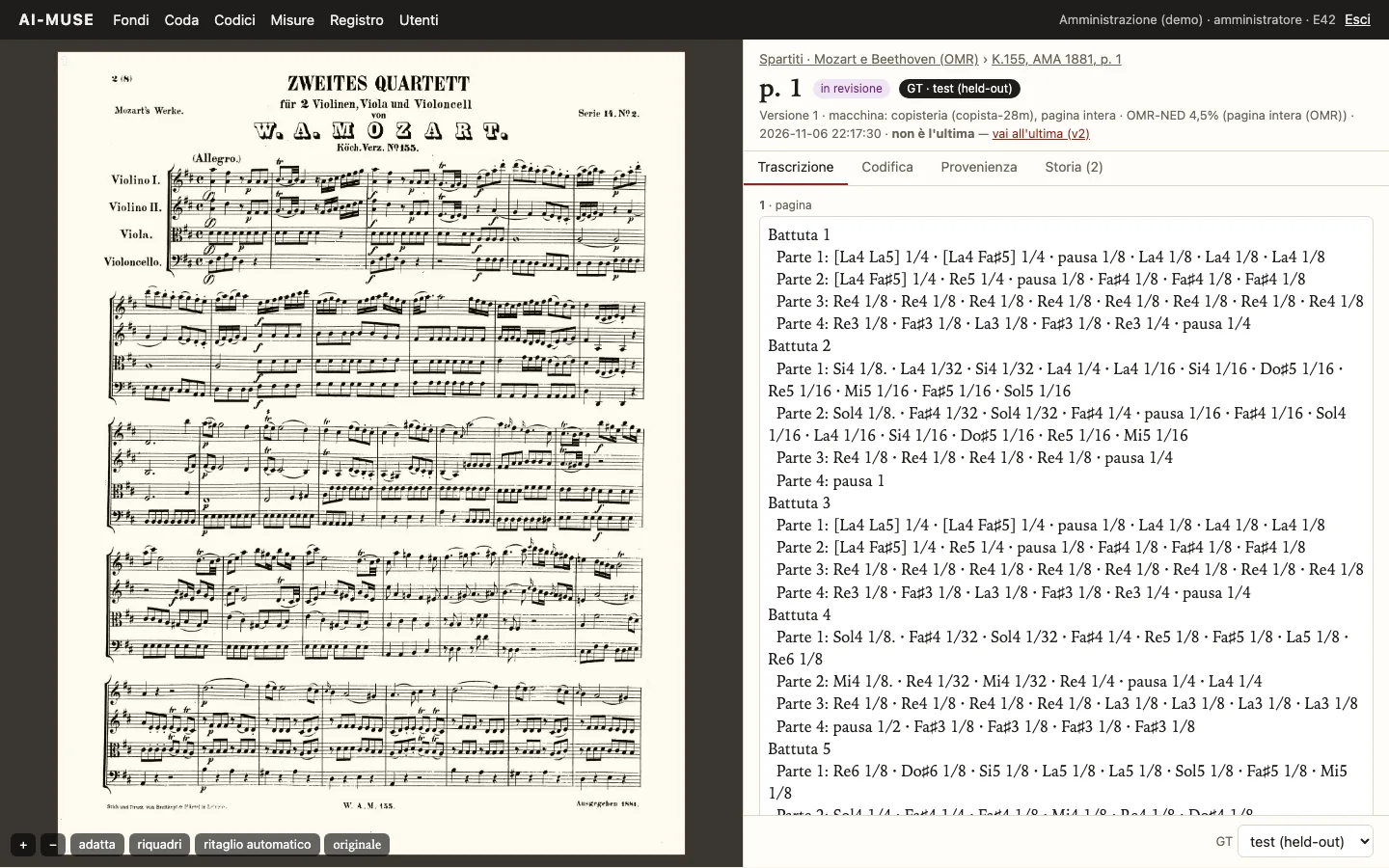
Music is text too, for an archive: a score is read into MusicXML and checked symbol by symbol. We tested four pages with a transcription made by people: three quartets in their 19th-century printed editions, and the first page of Mozart's own manuscript of K.155. The printed pages come out with 4.5 to 7.8% of symbols wrong. The manuscript is not read at all yet, and that is the next thing to train for.
Sources: autograph of K.155, Staatsbibliothek zu Berlin, Public Domain Mark; printed editions, IMSLP; transcriptions, OpenScore String Quartets, CC0, with page breaks from OSSQ-OMR.