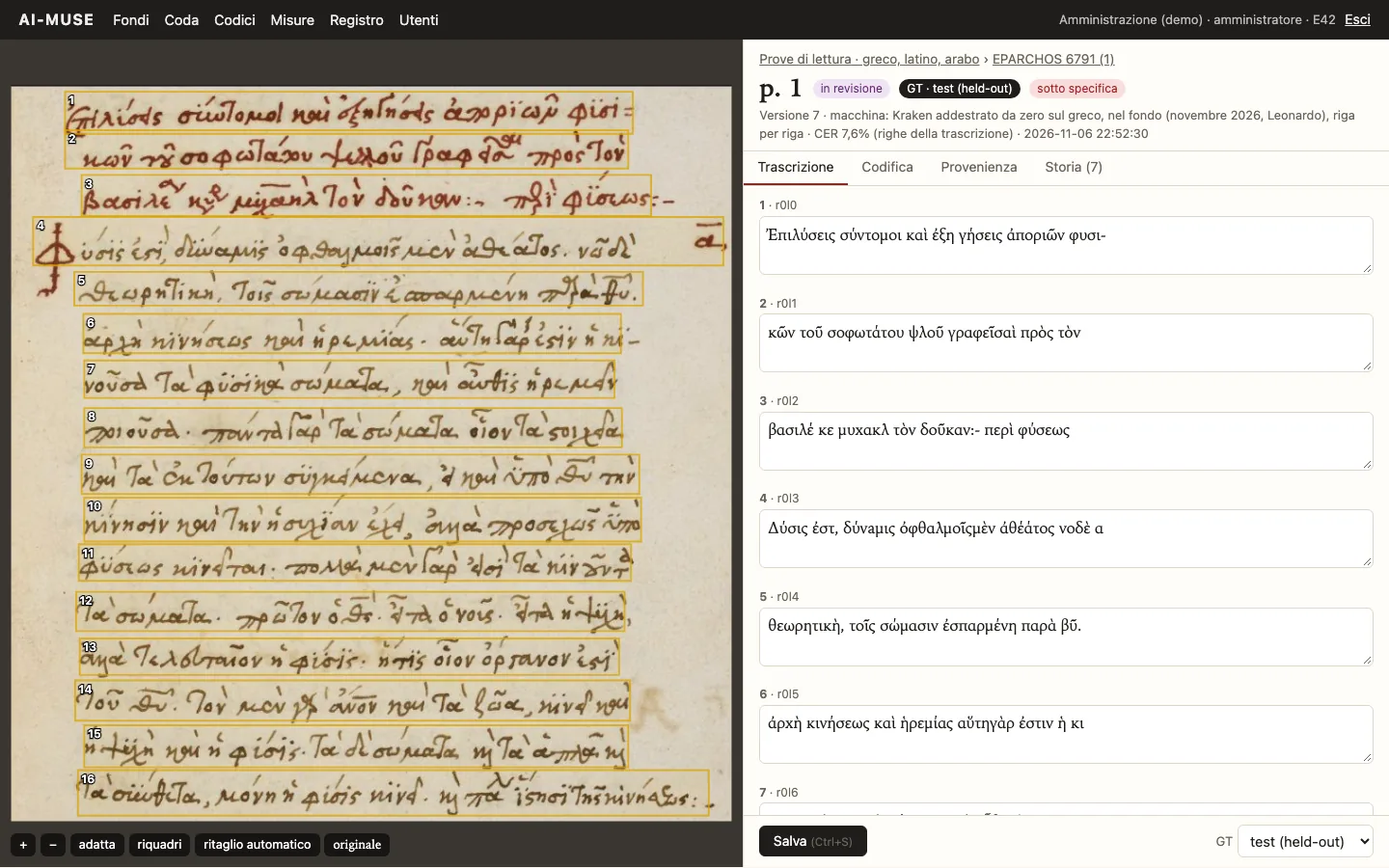
How it works
A page goes through five stages. Four are done by software. The fifth is a person saying yes, and nothing is published without it.
1 · Intake
Every file is fingerprinted and every item has its rights
Each scan gets a SHA-256 fingerprint, its size and resolution are checked, and a scan below specification is flagged rather than silently accepted. Rights are recorded per item, by the institution. Material whose rights are unclear is stored and can be looked at, but the reading queue refuses it.
2 · Cutting
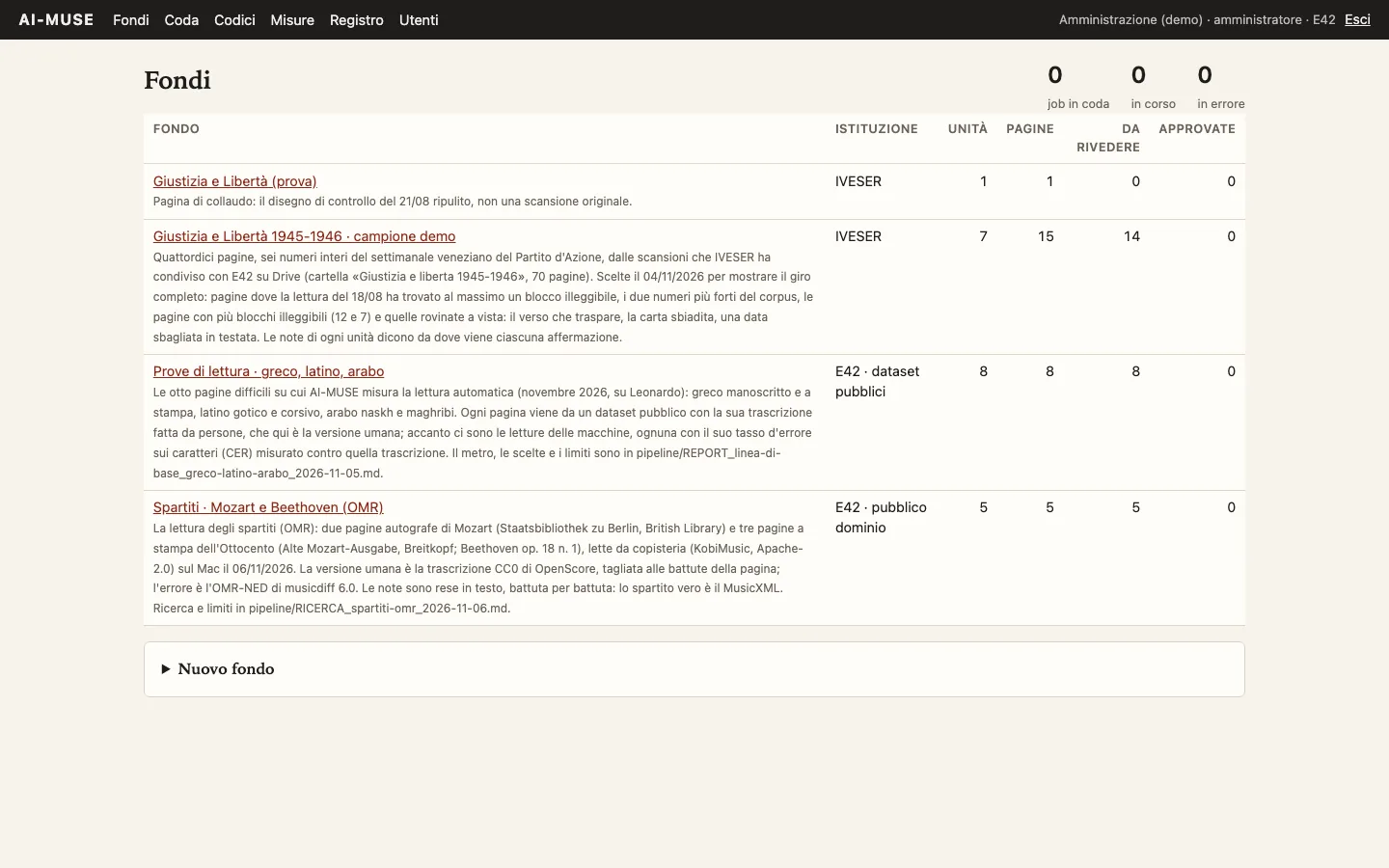
One click, and the page is divided into blocks
A newspaper page is six columns, headlines that cross them, photographs and advertisements. Read as a whole, models lose their place and start repeating themselves. So the page is first cut into blocks, following the ink, and each block is read on its own: on this front page, 79 text blocks in under a second, with no GPU.
3 · Reading
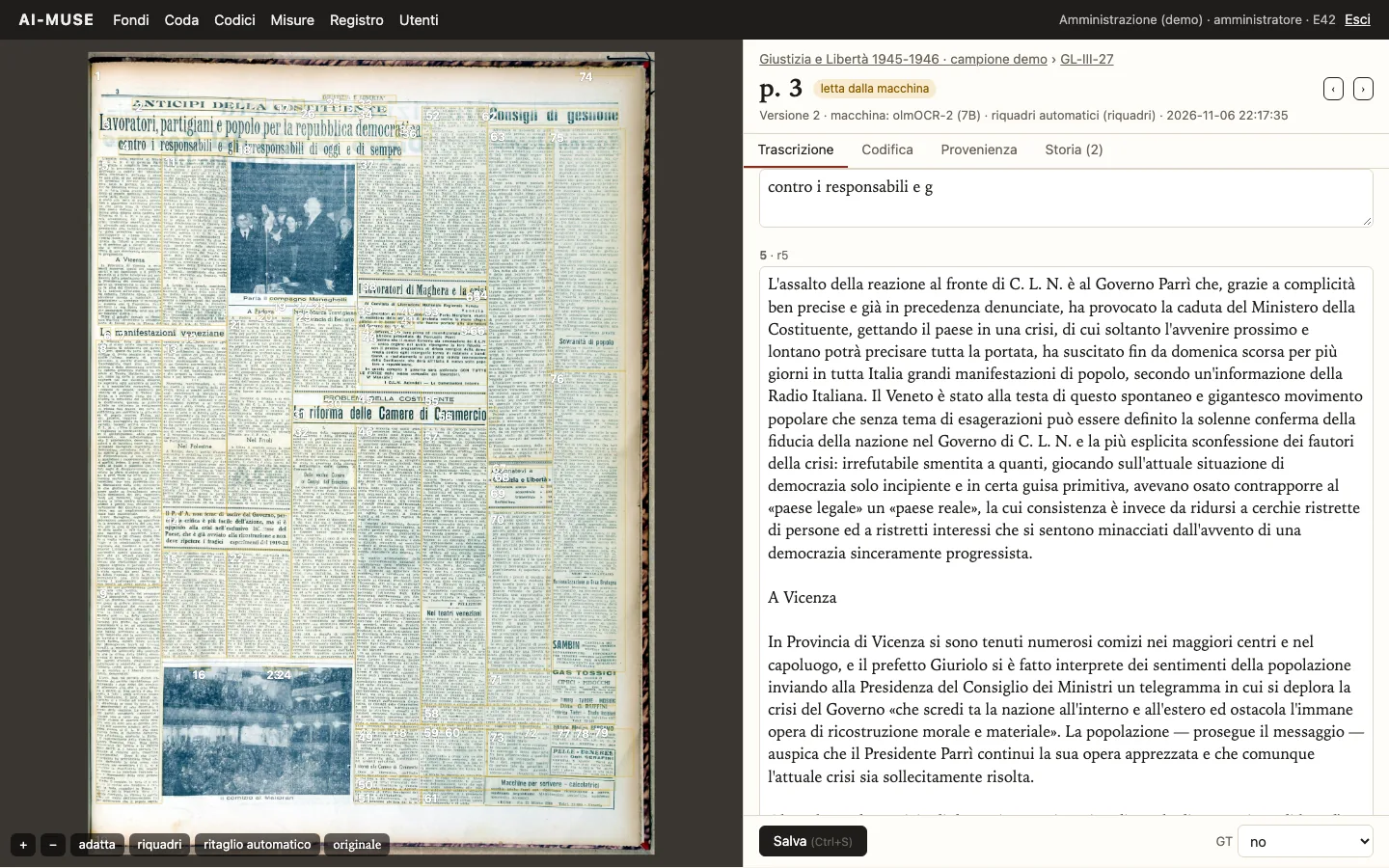
Each block goes to the model that reads that script best
For print, general-purpose vision-language models such as olmOCR-2 and LightOnOCR. For handwriting, line recognisers built with Kraken that we train on the collection itself. For music, copisteria, which writes MusicXML. Which model reads which material is decided by measurement, not by habit: see Results.
AI-MUSE has been granted compute resources through the IT4LIA AI Factory (EuroHPC), project EHPC-AIF-2026PG01-1068. Processing runs on Leonardo Booster at CINECA, Bologna.
4 · Review
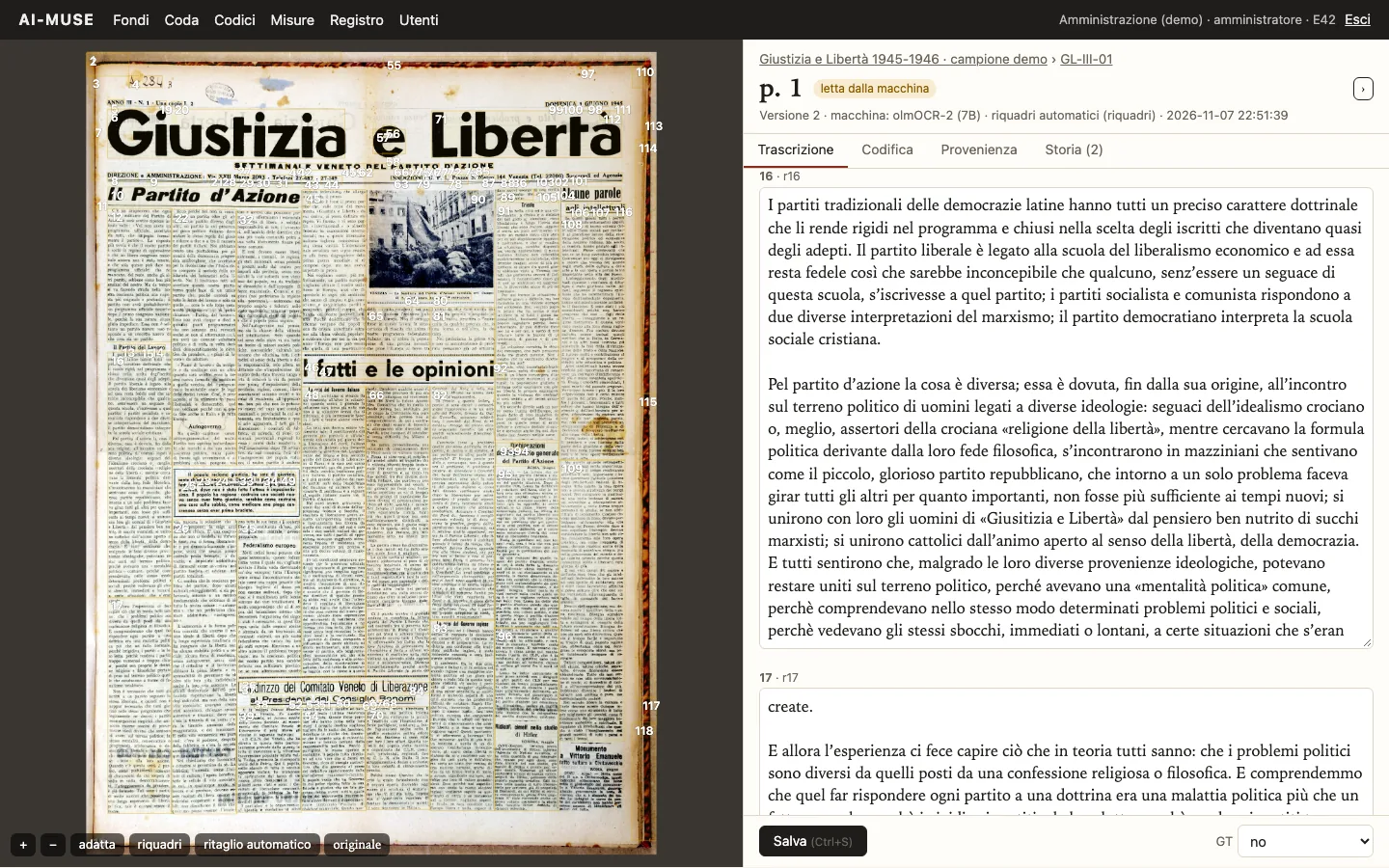
A person reads it, corrects it and approves it
Human-in-the-loop is our core architecture. We do not replace the scholar: we eliminate the exhausting chore of typing letters by hand, giving researchers supercomputing speed so they can focus on high-value historical judgment, context, and critique. What once took months of mechanical transcription is ready in hours for expert review.
The curator works in an editor that looks like the page: the scan on one side, the text on the other, the block under the cursor lit up on both. Every reading is kept with its model, method, date and compute job, so a correction never erases where the text came from.
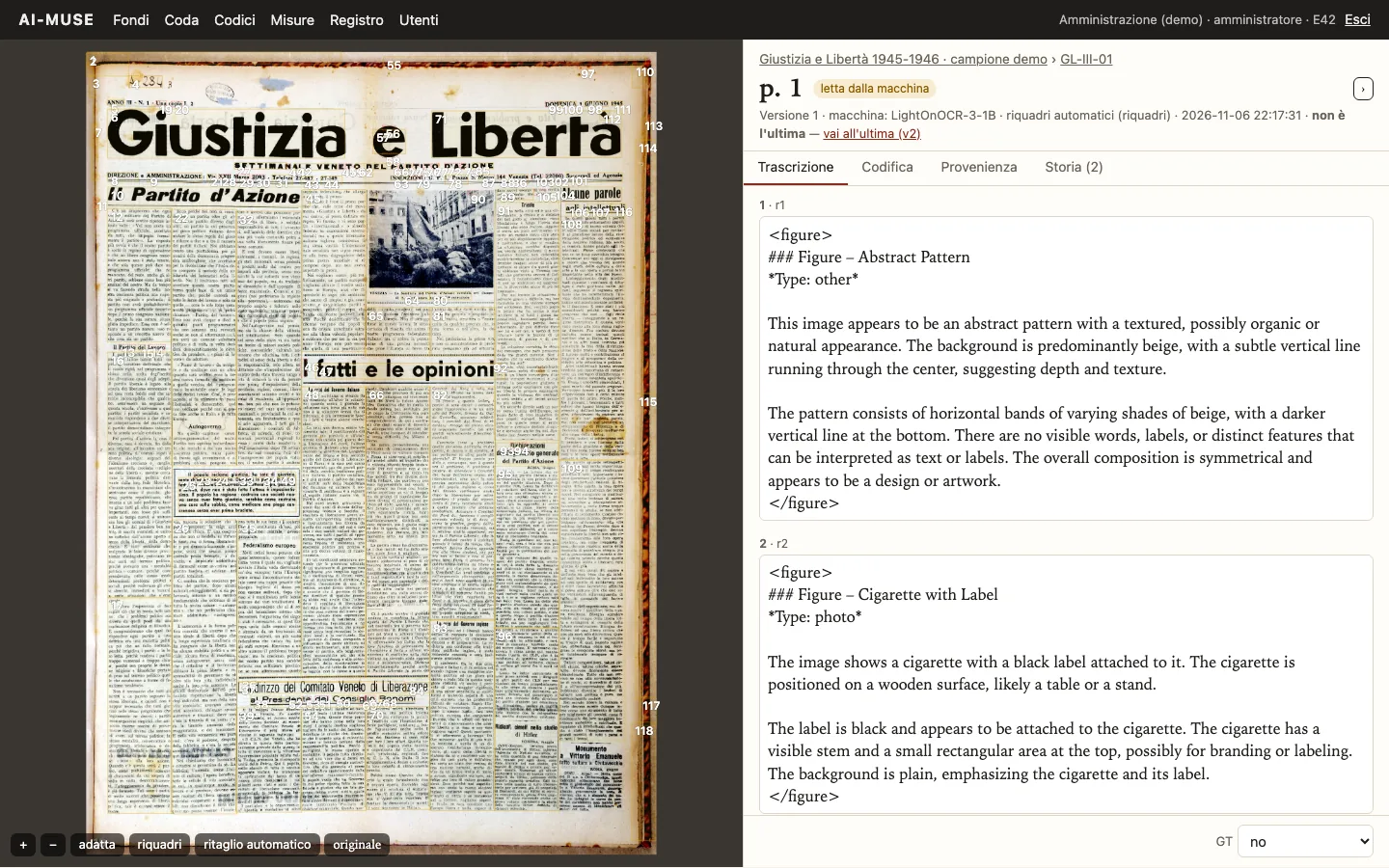
Some failures the editor can see: a model that loops, or stops halfway, gets a warning and a red box. Others it cannot. In this screenshot a general-purpose model, given a block of newsprint, describes «an abstract pattern» and «a cigarette with a black label». It reads as plausible English, and only a reader notices that none of it is on the page.
5 · Delivery
Only approved pages leave, and they carry their history
An approved page is exported as plain text, as PAGE XML with the coordinates of every block, and with a provenance record in W3C PROV that names the source scan, the model and its version, the person who approved it and the rights. Pages nobody has approved are not exported. Cultural institutions retain complete sovereignty over their data, archives, and trained models.
Behind the editor sits the human layer of the project: a metadata schema, a taxonomy and a codebook, and expert review of meaning, context, bias and omissions, designed by CREAaps.