
Two days on Leonardo: six times fewer errors
· AI-MUSE
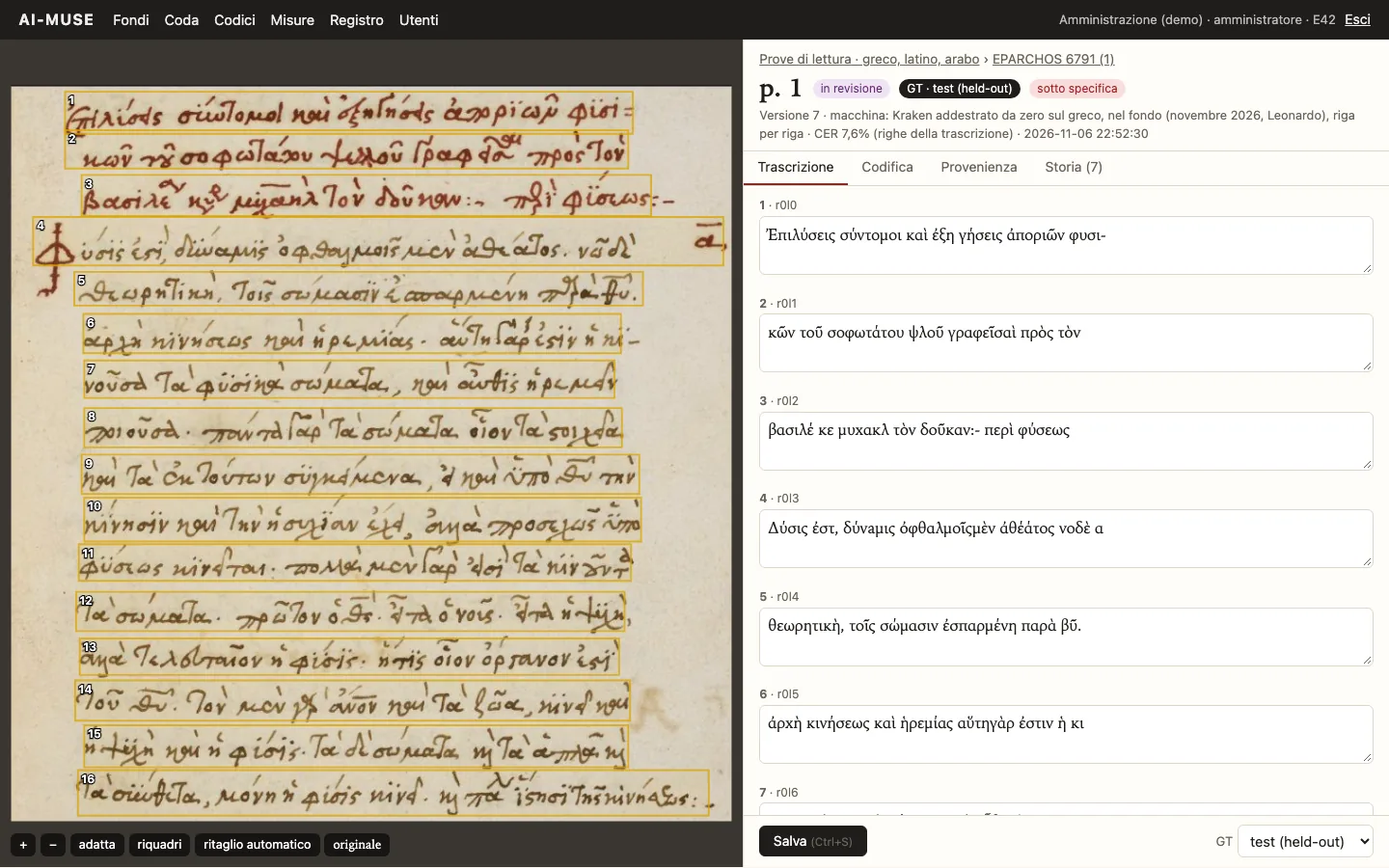
On a Greek hand of around 1500, the best general-purpose reading model gets almost one character in two wrong. Ours, trained on the rest of the same manuscript in a few hours on one GPU, gets fewer than one in thirteen wrong: six times fewer errors. On 5 and 6 November 2026 we trained ten models like it on Leonardo, the supercomputer of CINECA in Bologna, read a newspaper of 1945 and tried four pages of string quartets. This is everything that came out, including what did not work.
The question
General-purpose reading models learn mostly from modern print. On six of our eight test pages, the best of them gets more than a third of the characters wrong. The idea behind AI-MUSE is that a curator corrects some pages of a collection, a small model learns that hand from them, and it reads the rest. We wanted to know how far that gets, measured on pages the models never saw.
Ten models in a day
We trained line recognisers with Kraken on lines cut from public datasets with transcriptions made by people, all under licences that allow it: Greek minuscule and cursive, printed polytonic Greek, Latin, Christian Arabic and Maghribi script. Each run took one A100 GPU for one to three hours; on 6 November alone, about 24 GPU hours went into ten training runs, two calibrations and the newspaper. Eight test pages stayed out of training throughout.
- 7.6%of characters wrong on Greek cursive of around 1500. The best general-purpose model: 46.9%.
- 1.2%on printed polytonic Greek, Patrologia Graeca. Before: 4.9%.
- 20.5%on Maghribi Arabic script of 1734. Before: 34.8%.
These models were trained from scratch and never saw the test page, so the figures are clean. Fine-tuning a public base model goes lower still, 4.3% on the same Greek page, but that base model had some of our test pages in its own training data, so we report its figures as a ceiling, not a measurement. On Latin, fine-tuning takes a documentary cursive of Notre-Dame of Paris from 50.5% to 17.1%, and a model trained from scratch, which finished the following night, reaches 21.1%.
Where we are not better
We also asked the harder question: what happens on a hand the model has never seen, with the whole manuscript kept out of training? There our small models are not better than the best published ones: 31.5% against 24.5% on a Greek minuscule of the 15th century, 25.9% against 22.5% on Maghribi script. With nine to eighteen thousand lines per script, a model learns the hands it is shown, not the script in general. On Christian Arabic naskh we are level with the best general model even inside the collection: 17.5% against 18.2%.
That is why the project trains on each collection, with pages its own curators have corrected.
A newspaper of 1945, read twice
We read fourteen pages of «Giustizia e Libertà», the Venetian weekly of the Partito d'Azione, about 1,300 blocks, with two general-purpose models. Scans courtesy of IVESER. olmOCR-2 stopped early once. LightOnOCR-3-1B, the best general model on the manuscripts above, looped or stopped early 355 times, and on some blocks described pictures that are not on the page: an abstract pattern, a cigarette with a black label.
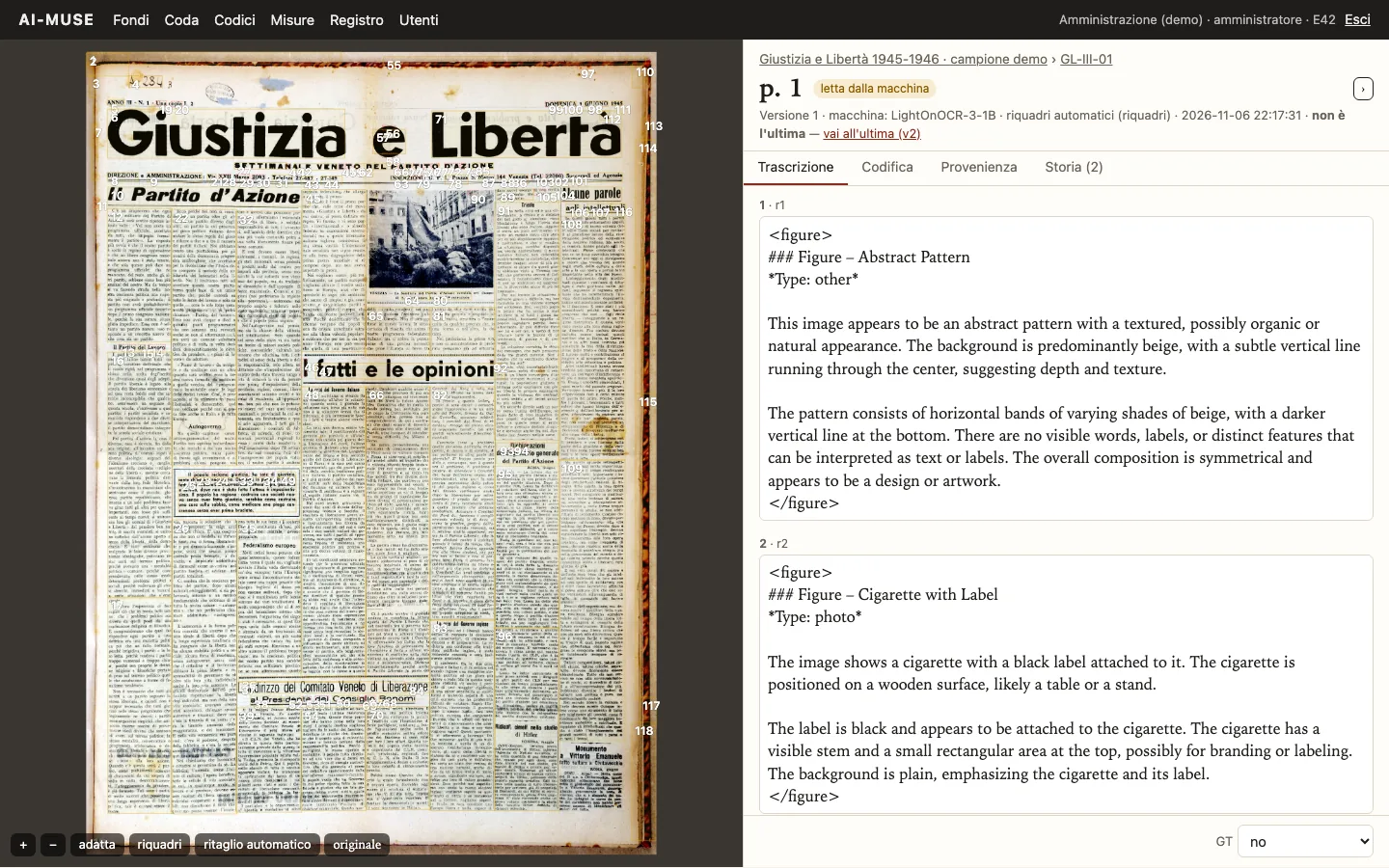
The editor flags loops and truncated blocks by itself. Invention it cannot catch: it reads as plausible English, and only a person who looks at the page sees that none of it is there. Both readings are in the editor for IVESER's curators to compare and correct, and their corrections will give the first measured error rate on this newspaper.
Mozart
For an archive, music is text too. copisteria, an open-source model, read four pages of string quartets into MusicXML, and we compared them symbol by symbol with transcriptions made by people: 4.5% of symbols wrong on Mozart's K.155 in the edition of 1881, 6.5% on K.465, 7.8% on Beethoven's op. 18 no. 1.
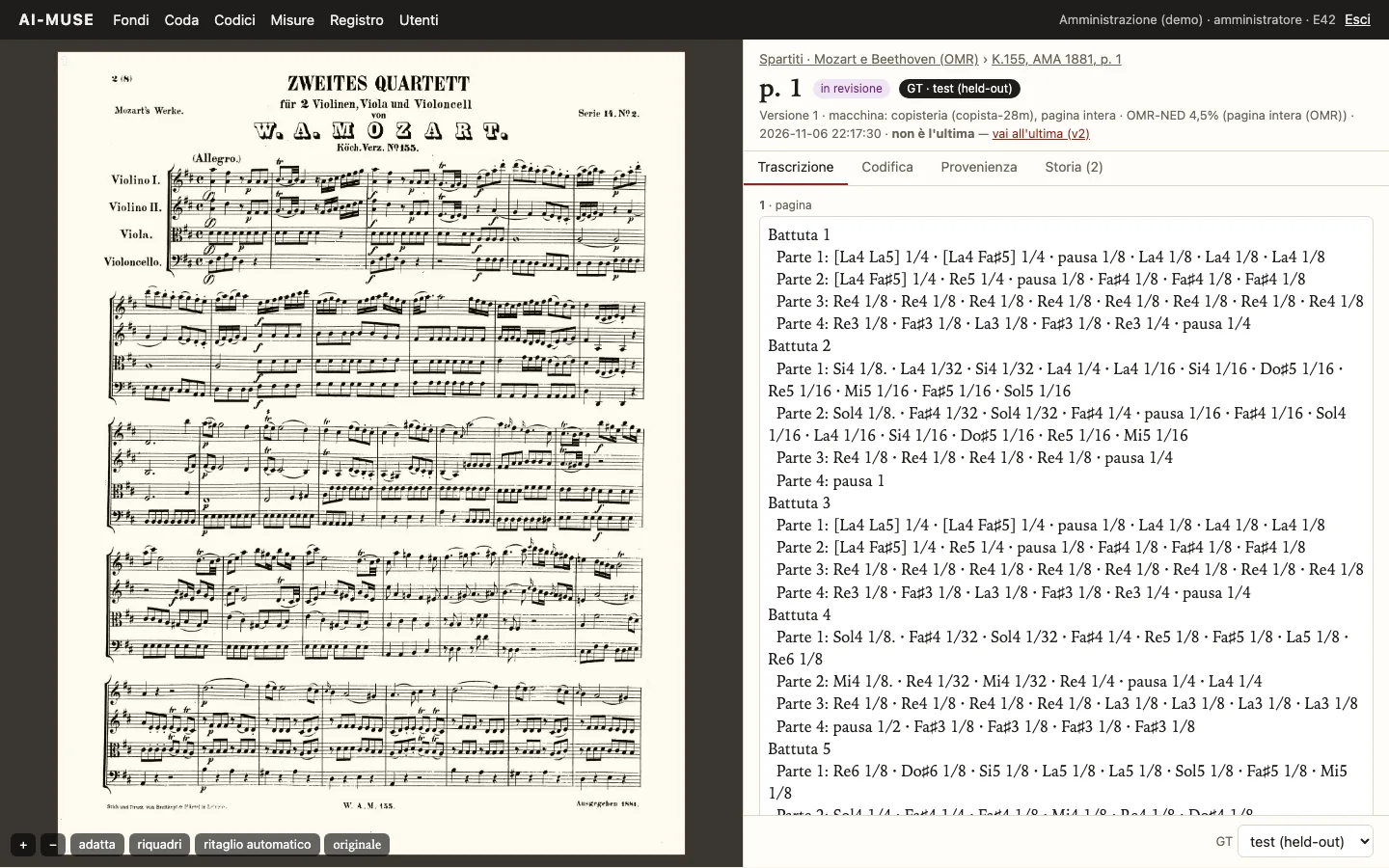
On the first page of Mozart's own manuscript of K.155 it fails completely, 96.9%: it sees eight parts of five bars instead of four parts of fourteen. Reading a composer's hand is the next thing to train for.
What it means
Inside a collection, a model trained on its own pages beats the general-purpose ones by a wide margin on Greek and on Maghribi script. On a hand it has never seen, it does not, yet. And a fluent reading can be pure invention. Every figure here is on the Results page with its sources, and every reading is in the application, waiting for a person to say yes.
AI-MUSE has been granted compute resources through the IT4LIA AI Factory (EuroHPC), project EHPC-AIF-2026PG01-1068. Processing runs on Leonardo Booster at CINECA, Bologna. We acknowledge EuroHPC JU for awarding the project ID EHPC-AIF-2026PG01-1068 access to 5,000 GPU hours on Leonardo Booster hosted by CINECA, Italy.