
Venice · Larnaca · İstanbul
Archives in. Checked text out.
Most of what archives hold has never been read by a machine, because the machines read it badly. AI-MUSE cuts each scanned page into blocks, reads them with models trained for that kind of script, and puts the result in front of a person who knows the material. Nothing leaves without their approval.
We do not replace paleographers and historians: we liberate them from mechanical transcription. What once took months of manual typing is now ready in hours for expert historical review, critical context, and discovery.
How it works
Three steps, and the last one is a person
-
Cut
The page is divided into blocks: columns, headlines, photographs, lines of handwriting. On the newspaper in the tour that is 107 blocks in half a second, on an ordinary server.
-
Read
Each block goes to a recognition model. We compare general-purpose models with ones we train ourselves for each script, and we use whichever is measurably better.
-
Check
The text appears next to the scan, block by block. The scholar shifts from the tedious chore of manual re-typing to high-value historical critique: correcting nuances, identifying bias, and approving the final record. Human judgment remains sovereign.
The five stages in detail, with screenshots
Results
Measured on pages the models never saw
Every figure here is the share of characters read wrong, against a transcription made by people, on test pages kept out of training.
- 7.6%Greek handwriting of around 1500, model trained from scratch on the rest of the codex. The best general-purpose model gets 46.9% wrong.
- 1.2%Printed polytonic Greek, Patrologia Graeca. Best general-purpose model: 4.9%.
- 20.5%Maghribi Arabic script of 1734. Best general-purpose model: 34.8%.
- 4.5%of musical symbols wrong on a printed Mozart quartet, read into MusicXML.
All the numbers, including where we are not better yet
From the blog · 7 November 2026
Two days on Leonardo: six times fewer errors
Ten models trained in a day on the Leonardo supercomputer. On a Greek hand of around 1500, the best general-purpose model gets almost one character in two wrong; ours, trained on the rest of the manuscript, fewer than one in thirteen. Plus a model that invents a cigarette, and Mozart's own hand, not read at all.
Case studies
A newspaper of the Liberation, read in a day
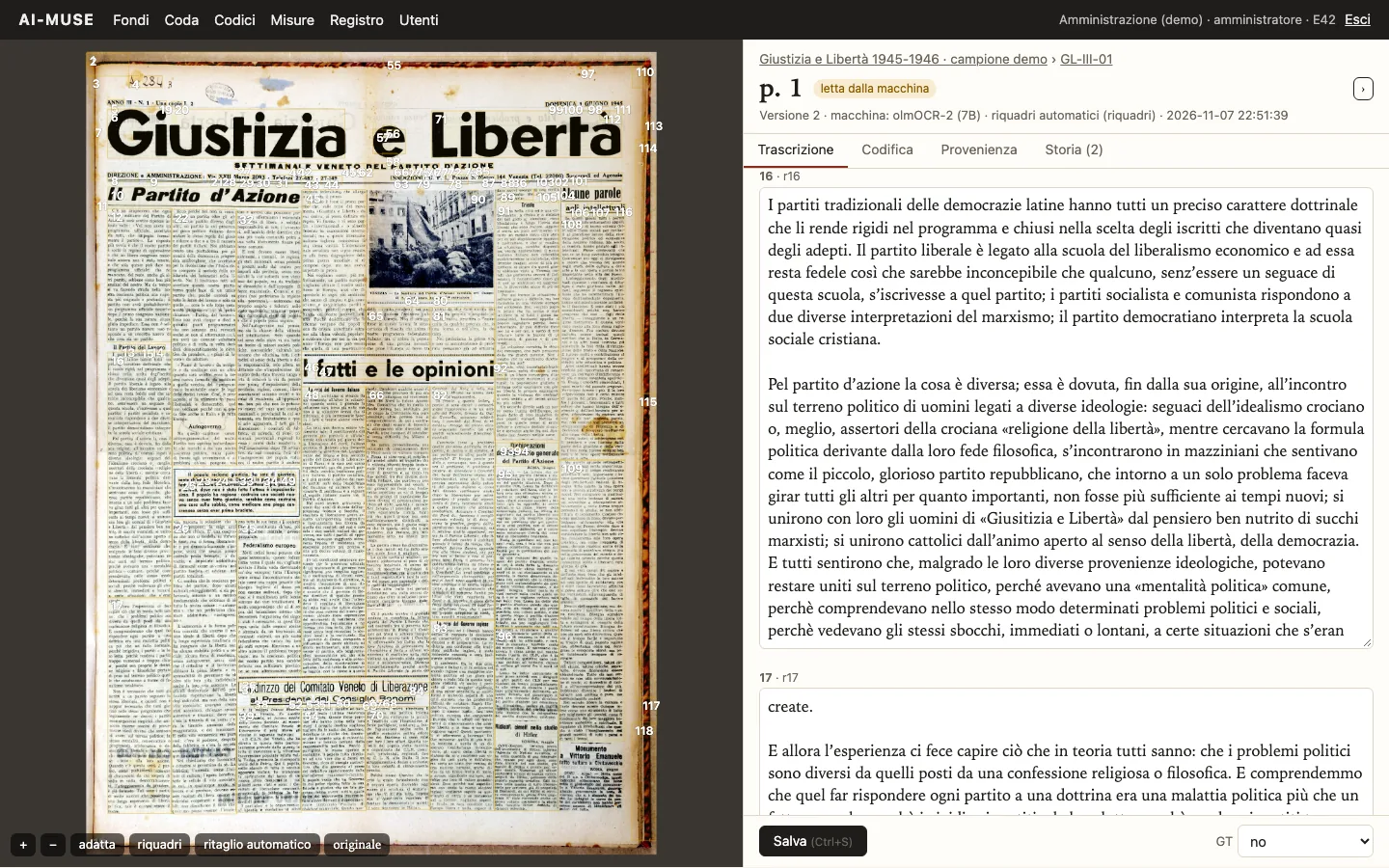
Fourteen pages of the weekly that the Partito d'Azione printed in Venice after the Liberation, read on 6 November 2026 by two models on the Leonardo supercomputer. One of them reads the columns cleanly. The other, on the same pages, writes fluent descriptions of photographs that are not there. Both readings are in the editor, side by side, and that difference is the reason AI-MUSE exists.
Newspapers, manuscripts and sheet music
For archives, libraries and museums
We are looking for institutions with material that is hard to read: handwriting, damaged print, scripts other than Latin, music. Give your researchers supercomputing power to save months of repetitive work, without ever losing sovereign control over your collections and data. Send us five difficult pages with a transcription if you have one, and we will tell you, with numbers, what the system gets right and where it fails.